
Nissan Rogue vs Toyota RAV4: Which SUV Should You Buy
Nissan Rogue vs Toyota RAV4: Which SUV Should You Buy
Posted on April 6, 2026
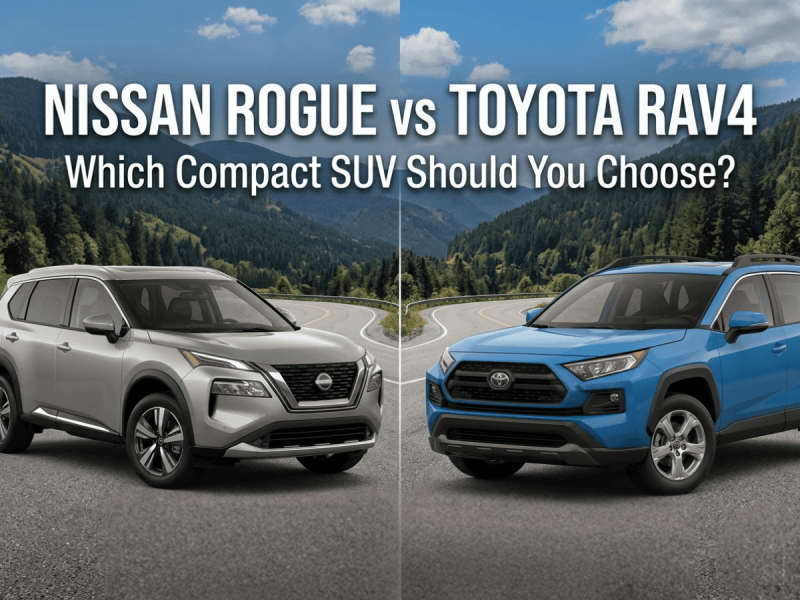
The Nissan Rogue and Toyota RAV4 have traded blows at the top of Canada's compact SUV sales charts for years. Both are genuinely good vehicles. Both will handle your morning commute, a Costco run, and a Georgian Bay road trip without complaint. The problem is they appeal to slightly different buyers, and picking the wrong one is an expensive mistake.
This comparison is for Kitchener families who want the space and practicality of a compact SUV without overpaying, commuters watching fuel costs creep up, and first-time SUV buyers who don't want to read six separate reviews to get a straight answer. We'll give you that straight answer here, backed by real numbers.
Quick verdict: If fuel efficiency and interior refinement are your top priorities, the Rogue wins. If you want hybrid options, better resale value, or greater terrain versatility, the RAV4 is the smarter play
| Specification | Nissan Rogue 2026 | Toyota RAV4 2026 | Rogue Advantage | RAV4 Advantage |
| Engine | 1.5L VC-Turbo 3-cyl | 2.5L 4-cyl | Smoother turbo power | Proven, larger engine |
| Horsepower | 201 hp | 203 hp (gas) | Near identical | Near identical |
| Fuel (L/100km) | 8.1 city / 6.9 hwy | 8.7 city / 7.1 hwy | Better city mileage | Close on the highway |
| Cargo (behind 2nd row) | 1,110 L | 1,059 L | More cargo space | |
| Seating | 5 | 5 (7 with XL trim) | Optional 3rd row | |
| AWD | Intelligent AWD + Snow Mode | Multi-Terrain Select | Snow-specific mode | More terrain modes |
| Starting MSRP (CAD) | ~$34,000 | ~$33,000 | Lower entry price |
Performance and Powertrain
The Rogue runs a 1.5L variable compression turbocharged engine, which sounds exotic on paper and delivers 201 hp with genuinely smooth throttle response in practice. Variable compression is a Nissan-exclusive technology that adjusts the compression ratio on the fly depending on load, which is part of why the Rogue achieves such strong fuel economy without sacrificing power. Around Kitchener, where you're spending a lot of time in mixed city-and-highway traffic on the 401, the Rogue's low-end torque makes it feel more relaxed than the numbers suggest.
The RAV4's 2.5L four-cylinder is the more traditional setup and pulls to 203 hp. It's responsive, utterly proven over millions of kilometres, and pairs with an 8-speed automatic that shifts cleanly. Where Toyota gains serious ground is the hybrid lineup. The RAV4 Hybrid (219 hp combined) and RAV4 Prime PHEV are available if fuel costs are a concern, which changes the comparison entirely if you're willing to spend slightly more upfront. Nissan's e-POWER option is not currently available in Canada in the Rogue, which is worth noting.
For a straight, daily driving feel, both are confident and composed. The Rogue is quieter inside at highway speeds. The RAV4 feels slightly more planted in corners, which matters more on winding roads than in the Kitchener suburbs.
Fuel Efficiency
At current Canadian gas prices hovering around $1.55 to $1.70 per litre in southern Ontario, the difference between the two matters across a full ownership period. The Rogue averages around 8.1 L/100km city and 6.9 highway. The RAV4 gas trim comes in at roughly 8.7 city and 7.1 highway. That gap is over 20,000 km per year.
Run the numbers on a 3-year ownership cycle at 20,000 km annually, and the Rogue saves roughly $300 to $450 per year in fuel over the standard RAV4 gas trim. If you're comparing against the RAV4 Hybrid, that flips. The Hybrid averages closer to 6.0 L/100km combined, which erases the Rogue's advantage completely and then some.
Bottom line on fuel: if you're buying the gas-only version of either vehicle, the Rogue is the more economical choice. If Toyota's hybrid pricing works within your budget, that changes the calculus.
Interior, Comfort and Tech
The Rogue's interior is where Nissan made the biggest strides over the previous generation. The materials step up noticeably at the SV trim and above, with zero-gravity front seats that genuinely reduce fatigue on longer drives, a clean dashboard layout, and standard Google Built-in on most trims, meaning Google Maps, Google Assistant, and the Play Store run natively without needing your phone connected. For commuters who take calls and navigate constantly, this is a meaningful convenience upgrade.
The RAV4's cabin is functional and durable, qualities Toyota buyers expect and typically get. It doesn't feel as premium as the Rogue at the same price point, but the infotainment system has improved with the latest multimedia update. Apple CarPlay and Android Auto are standard. Toyota Safety Sense, which includes pre-collision braking, lane departure alert, and adaptive cruise, comes standard across all RAV4 trims.
The Rogue counters with ProPilot Assist on higher trims, a hands-on highway driving assistance system that handles steering, speed, and following distance with a level of smoothness that Nissan drivers tend to find genuinely useful on 401 runs between Kitchener and Toronto.
Interior winner: Rogue at equivalent trim levels, particularly for tech integration.
Read More: AWD vs FWD vs 4WD: What's the Difference and Which One Do You Need?
Cargo and Practicality
The Rogue carries 1,110 litres behind the second row, compared with the RAV4's 1,059 litres. With both rows folded, it's 2,020L in the Rogue and 1,977L in the RAV4. Neither is a dramatic win, but the Rogue has a consistently flatter load floor, which makes loading awkward furniture or a bike significantly easier.
Towing is comparable at 680 kg (1,500 lb) for the Rogue and 680 to 907 kg for the RAV4, depending on trim and whether you're in AWD. For trailer-towing families, the RAV4's higher-rated figures on certain trims give it an edge.
The RAV4 XL trim is worth considering for larger families, as it offers a third-row bench seat. It's genuinely tight back there and, realistically, only for kids, but the option exists in the RAV4, not the Rogue.
AWD and Winter Performance
This section matters more in Kitchener than it might in Vancouver. Winter tires are a given, but the quality of your AWD system determines how confidently you handle that first heavy snowfall in November, before anyone's mentally adjusted back to winter driving.
The Rogue uses Nissan's Intelligent AWD system, which includes a dedicated Snow mode that adjusts throttle response, traction control thresholds, and torque distribution to reduce wheel spin on slippery surfaces. It's not a gimmick. Drivers who've used it in real Ontario winter conditions consistently find it one of the more confidence-inspiring setups in the class.
The RAV4 runs Toyota's AWD-i system with Multi-Terrain Select on most trims, offering Mud, Sand, Rock, and Snow modes. In Kitchener, Snow mode is what you'll use 99% of the winter, and both systems perform similarly in that specific scenario. The RAV4 TRD Off-Road trim goes further for buyers who actually venture off-road, but that's a niche within a niche.
Reliability and Ownership Costs
Toyota's reputation for long-term reliability is well-earned and reflected in resale values that consistently outperform the segment. J.D. Power's latest dependability studies place the RAV4 above average in its segment, and Consumer Reports readers rate it highly for long-term ownership satisfaction. If buying used matters to you, a 3-year-old RAV4 holds its value better than nearly anything else in this class.
The Rogue has improved substantially in reliability rankings over the past two generations. The current generation receives above-average reliability scores from J.D. Power, a meaningful shift from earlier Rogue generations that received mixed reviews. Maintenance costs for both vehicles are reasonable, with Toyota's slightly larger service network across Canada being a practical advantage for buyers who travel frequently.
Ownership cost reality: the Rogue's stronger fuel economy and competitive maintenance pricing narrow the total cost-of-ownership gap created by Toyota's better resale value. For buyers planning to keep the vehicle 5 or more years, the reliability difference shrinks significantly.
Pricing and Trim Breakdown
Nissan Rogue 2026 (CAD Estimates)
- S: ~$34,000 (base, good standard kit)
- SV: ~$37,500 (adds heated seats, larger display, ProPilot Assist)
- SL: ~$41,000 (adds Bose audio, panoramic sunroof, leather)
- Platinum: ~$45,000+ (fully loaded, head-up display, premium finishes)
Toyota RAV4 2026 (CAD Estimates)
- LE: ~$33,000 (base, strong standard safety kit)
- XLE: ~$37,500 (most popular trim, adds convenience features)
- TRD Off-Road: ~$42,500 (off-road tuning, unique styling)
- Limited: ~$46,000+ (premium interior, full tech suite)
- Hybrid XLE: ~$42,000+ (significant fuel savings, higher long-term value)
Value verdict by segment: at the $34,000 to $39,000 range, where most buyers land, the Rogue SV offers more standard technology than the RAV4 XLE at the same price. Above $42,000, the RAV4 Hybrid becomes a compelling argument on its own terms.
Who Should Buy Which?
Buy the Nissan Rogue if:
- Fuel efficiency on a non-hybrid budget is a priority
- Interior quality and tech features matter at a lower trim price
- You want Google Built-in and ProPilot Assist without going to a high trim
- Cargo space and a flat load floor are important for daily practicality
- You're commuting regularly on the 401 and want a quieter, more relaxed highway cruiser
Buy the Toyota RAV4 if:
- Long-term resale value is a top consideration
- You want a hybrid or PHEV option
- You need a third-row option for a larger family
- You prioritize Toyota's long-standing reliability track record
- You tow regularly and need the higher-rated towing capacity
Test Drive Both at Tabangi Motors in Kitchener
Reading comparisons is useful. Sitting in both vehicles back-to-back is what actually makes the decision clear. The zero-gravity seats in the Rogue, the driving position in the RAV4, the actual sound of the infotainment systems — none of that comes through in a spec sheet.
Tabangi Motors is a Nissan dealer serving Kitchener and the surrounding Region of Waterloo. We carry new and used Nissan Rogue inventory in Kitchener with transparent pricing and no-pressure test drives. If you want to talk options, compare trims, or run the numbers
on financing, our team handles it the way you'd want — straightforwardly.
Book a test drive or browse current inventory at kitchener.tabangimotors.com. Walk-ins welcome at our Kitchener location.
Read More: What Is OMVIC and Why It Matters When Buying a Used Car in Ontario
Common Questions About the Nissan Rogue vs. the Toyota RAV4
1. Is the Nissan Rogue better than the Toyota RAV4?
The Nissan Rogue is better than the RAV4 in fuel efficiency, interior technology, and cargo space at comparable non-hybrid trim levels. The RAV4 wins on long-term resale value, hybrid availability, and proven reliability history. Which is 'better' depends entirely on your priorities; for most Kitchener commuters prioritizing fuel cost and tech, the Rogue offers more per dollar in the $34,000 to $40,000 range.
2. Which has better fuel economy: the Nissan Rogue or the Toyota RAV4?
The Nissan Rogue has better fuel economy than the standard RAV4 gas trim, averaging approximately 8.1 L/100km in the city versus the RAV4's 8.7 L/100 km. If you're comparing the Rogue to the RAV4 Hybrid, the Hybrid wins comfortably, with a combined fuel economy of around 6.0 L/100km. For buyers staying within the gas-only options, the Rogue saves roughly $300 to $450 annually at current Ontario fuel prices.
3. What is the starting price of the Nissan Rogue in Canada in 2026?
The 2026 Nissan Rogue starts at approximately $34,000 CAD in the base S trim with AWD. The most popular SV trim, which adds heated seats, a larger display, and ProPilot Assist, sits around $37,500. Pricing varies by province and dealer; contact Tabangi Motors in Kitchener for current local pricing and available inventory.
4. Which is more reliable: the Nissan Rogue or the Toyota RAV4?
The Toyota RAV4 has a longer-established reliability track record and slightly higher long-term owner satisfaction scores across most third-party studies. The current-generation Rogue has improved significantly over earlier models and now scores above average in J.D. Power dependability studies. For buyers keeping a vehicle 7 or more years, Toyota's reliability edge is more meaningful than for shorter ownership periods.
5. Can I get a hybrid Nissan Rogue in Canada?
The Nissan Rogue e-POWER hybrid is not currently available in Canada. Canadian buyers interested in a hybrid Rogue cannot get that configuration through Canadian dealers as of 2026. If a hybrid powertrain is essential to your purchase decision, the Toyota RAV4 Hybrid or RAV4 Prime PHEV are the main alternatives in the compact SUV class currently sold in Canada.
6. Which SUV has more cargo space: the Rogue or the RAV4?
The Nissan Rogue has more cargo space than the RAV4, offering 1,110 litres behind the second row compared to the RAV4's 1,059 litres. The Rogue also benefits from a flatter load floor when the rear seats are folded, making it easier to load larger items. For buyers frequently loading bikes, strollers, or flat-pack furniture, the Rogue's cargo configuration is more user-friendly.