
AWD vs FWD vs 4WD: What's the Difference and Which One Do You Need?
AWD vs FWD vs 4WD: What's the Difference and Which One Do You Need?
Posted on April 14, 2026
Most drivers never think about their drivetrain until they are sliding through a snowy intersection or standing in a dealership lot trying to decode a window sticker. But your drivetrain is one of the most important decisions you will make when buying a vehicle. It shapes how your car handles in bad weather, how much you spend at the pump, and how much maintenance you are signing up for over the years.
This guide breaks down the three main drivetrain systems in plain terms so you can make a confident, informed decision.
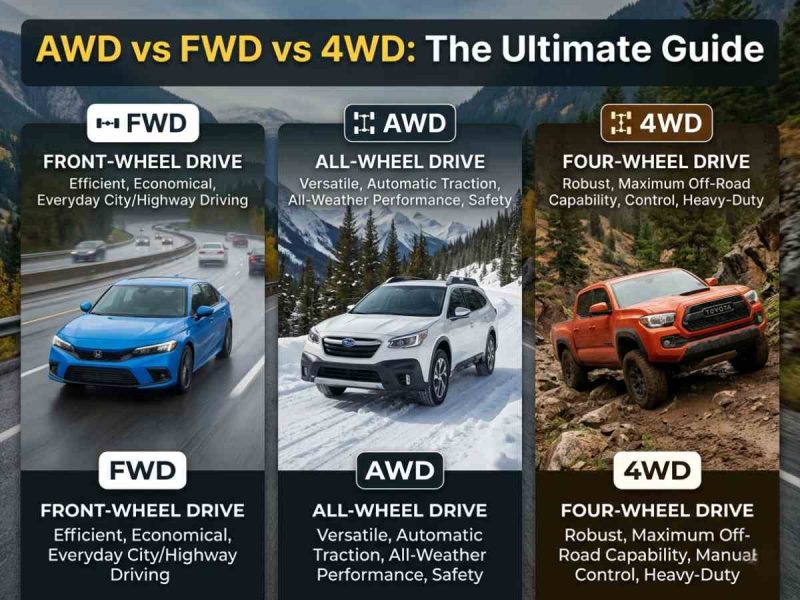
Quick Comparison: AWD vs FWD vs 4WD at a Glance
| Feature | FWD | AWD | 4WD |
| Power delivery | Front wheels only | All 4 wheels (auto) | All 4 wheels (manual/transfer case) |
| Best for | City driving, commuting | Snow, rain, mixed roads | Off-road, towing, rough terrain |
| Fuel economy | Best | Moderate | Worst |
| Purchase cost | Lowest | Mid to high | Mid to high |
| Driver input needed | No | No | Yes (engage/disengage) |
| Off-road capability | Poor | Limited | Excellent |
| Typical vehicles | Sedans, small SUVs | Crossovers, SUVs | Trucks, body-on-frame SUVs |
FWD: The Everyday Choice
Front-wheel drive sends all the engine power to the front two wheels. That is it. The front wheels handle both steering and driving the car forward, while the rear wheels simply roll along for the ride.
It sounds simple because it is, and that simplicity works in its favour. FWD vehicles are lighter, cheaper to produce, and easier to repair. There are fewer mechanical components, which means less that can go wrong. You will also notice better fuel economy than AWD or 4WD, since the drivetrain is not hauling around extra hardware.
In light snow and rain, FWD actually performs quite well. The engine weight sitting over the front wheels adds traction right where you need it most.
The downside shows up in deeper snow, sharp corners, or when you really push the car. FWD vehicles tend to understeer, meaning the front end pushes wide rather than turn cleanly. If you are hauling anything heavy or venturing off the pavement even slightly, FWD will feel out of its depth quickly.
FWD is the right fit for: city commuters, highway drivers, budget-conscious buyers, and anyone who lives somewhere with mild winters and mostly paved roads.
AWD: The All-Weather Performer
All-wheel drive is what most people picture when they think of a car that handles winter well. It sends power to all four wheels either continuously or automatically when the system detects wheel slip. You do not flip a switch or think about it at all. The car manages everything in the background.
There are two flavours worth knowing. Full-time AWD keeps power flowing to all four wheels at all times. On-demand AWD runs primarily on two wheels and shifts power to the other two only when traction drops. Most modern crossovers and SUVs use on-demand systems as a compromise between traction and efficiency.
AWD genuinely shines in Canadian winters, wet highways, and mixed road conditions. It gives you confidence without requiring any change in how you drive. That ease of use is a big part of why AWD has become the default choice for family SUVs and crossovers across the country.
The trade-offs are real, though. AWD systems add weight and complexity, which raises fuel costs and increases long-term maintenance. And while AWD is excellent on slippery roads, it is not designed for serious off-road use. It will get you through a snowy parking lot, but it will not get you up a rocky trail.
AWD is the right fit for families in snowy climates, crossover and SUV buyers, and daily drivers who want all-weather confidence without extra effort.
Read More: How Long Does It Take to Get Car Insurance
4WD: The Off-Road Workhorse
Four-wheel drive is the older and more rugged of the two systems. Rather than automatically distributing torque, 4WD requires you to actively engage it, usually through a transfer case lever or button. Most systems offer a high-range setting for loose gravel and snowy roads and a low-range setting for serious off-road crawling through mud, rocks, or sand.
Part-time 4WD is the traditional setup found on most trucks. You drive in two-wheel drive on normal roads and switch to 4WD when conditions call for it. Full-time 4WD keeps all four wheels engaged at all times, similar to AWD, though it is less common.
The raw traction capability of a proper 4WD system is hard to beat when you genuinely need it. If you tow a trailer regularly, drive on unpaved roads, or head into the backcountry, 4WD gives you the mechanical advantage to do it safely.
The cost shows up in fuel economy, ride quality on pavement, and upfront price. 4WD trucks are heavier and less efficient, and they are not meant to be driven in 4WD on dry pavement, as it can damage the drivetrain.
4WD is the right fit for: truck owners, off-road enthusiasts, anyone who tows regularly, and drivers in rural areas dealing with unpaved roads or heavy winter terrain.
AWD vs 4WD: What Is the Real Difference?
This is where most people get confused, and it is worth being direct.
AWD is road-focused. It works automatically and is built for passenger vehicles navigating rain, snow, and slippery pavement. You never have to think about it.
4WD is terrain-focused. It is built for trucks and body-on-frame SUVs going somewhere roads do not. It requires driver input and performs poorly if left engaged on dry pavement.
| Features | AWD | 4WD |
| Activation | Automatic | Manual (driver engages) |
| Best surface | Paved roads, snow, rain | Mud, rocks, deep snow, sand |
| Vehicle type | Cars, crossovers, SUVs | Trucks, Jeeps, full-size SUVs |
| On dry pavement | Safe to use always | Can cause drivetrain damage |
| Off-road ability | Limited | Excellent |
Which Drivetrain Should You Choose?
Here is the short version:
- You commute in a city or on highways and want good fuel economy: go with FWD.
- You deal with Ontario winters and want reliable traction without having to think about it: AWD is your answer.
- If you tow, go off-road, or regularly drive rural roads, 4WD is what you need.
Cost of ownership matters too. AWD and 4WD vehicles cost more upfront and more to run. Tires, fuel, and drivetrain servicing all add up. FWD keeps those costs down, which is a real advantage if your driving is mostly routine.
Browsing for your next vehicle? Check out the current inventory to compare options across all three drivetrain types.
The Bottom Line
FWD keeps things affordable and efficient. AWD gives you all-weather confidence with no effort required. 4WD is built for the toughest terrain and the heaviest jobs. None of them is universally best because the right choice depends entirely on where you drive, what you haul, and what winter looks like where you live.
If you are still weighing your options, the team at Tabangi Motors Kitchener can help you find the right vehicle for your needs and budget.
Read Next: Nissan Rogue vs Toyota RAV4: Which SUV Should You Buy
Frequently Asked Questions
1. Is AWD better than 4WD in snow?
For everyday snow and icy roads, AWD is more practical. It works automatically and handles typical winter conditions well. 4WD is better in deep, unpacked snow or off-road conditions where you need maximum traction and a low-range gear.
2. Does AWD use more gas than FWD?
Yes. AWD systems are heavier and have more mechanical components, which reduces fuel efficiency. The difference is usually between 1 and 3 mpg, depending on the vehicle.
3. Is AWD the same as 4WD?
No. They are often confused, but they work differently. AWD operates automatically and is designed for paved roads and light off-road conditions. 4WD is manually engaged and built for serious off-road use, such as mud, rocks, and deep snow. AWD is typically found on cars and crossovers, while 4WD is found on trucks and body-on-frame SUVs.
4. Can you switch from 4WD to 2WD while driving?
With most modern systems, yes, you can switch between high-range 4WD and 2WD at low speeds. Switching into or out of 4WD Low typically requires a full stop. Always check your owner's manual.
5. Is FWD safe in winter?
Yes, for most winter driving conditions. Combine FWD with a quality set of winter tires, and you will handle light to moderate snow without issue. Deep snow or off-road conditions are where FWD starts to struggle.
6. What is on-demand AWD vs full-time AWD?
Full-time AWD continuously sends power to all four wheels. On-demand AWD normally runs on two wheels and only shifts power to the other axle when the system detects wheel slip. Most modern crossovers and SUVs use on-demand AWD as it offers a better balance between traction and fuel efficiency.